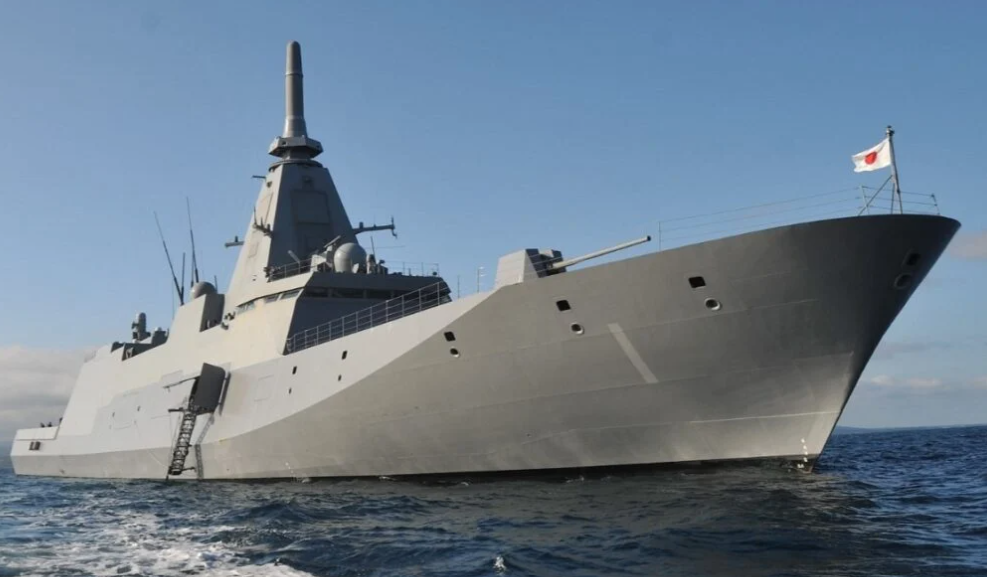
Rolls-Royce has secured the propulsion contract for Australia’s new general-purpose frigate fleet, with the Royal Australian Navy confirming the MT30 marine gas turbine will power up to 11 ships based on Japan’s upgraded Mogami-class design.
The selection follows Australia’s earlier decision to procure the upgraded Mogami-class frigate as its general-purpose naval frigate replacement. Japan’s Mogami-class already runs on the MT30, making the engine selection a natural continuation of the platform’s existing propulsion architecture. The first three frigates will be built in Japan by Mitsubishi Heavy Industries, with the first scheduled for delivery to Australia in 2029 and operational service in 2030. Subsequent vessels in the programme are expected to transition to Australian production over time.
The MT30 is manufactured at Rolls-Royce’s facility in Bristol, United Kingdom, where it is designed, assembled, and tested. In addition to the gas turbine, the upgraded Mogami-class frigates destined for Australia will be fitted with mtu Series 4000-based diesel generator sets from Rolls-Royce Power Systems, supplying onboard electrical power for ship systems. Those generator sets are supplied through Daihatsu InfinEarth, Rolls-Royce Power Systems’ established licensed partner for that product line. The combination gives Rolls-Royce a dual role in the programme — main propulsion through the MT30 and auxiliary power generation through its Power Systems division.
Alex Zino, Director of Business Development and Future Programmes at Rolls-Royce Defence, framed the award in the context of a century-long relationship between the company and Australia. “For over 100 years, Rolls-Royce has been an integral partner delivering power and propulsion to Australia for air, land, and sea,” Zino said. “We are delighted to continue this long-standing partnership by powering their new general-purpose frigates with our MT30 engine.” Zino also addressed the broader strategic dimension: “We are pleased to support this collaboration between two nations that are combining capabilities to enhance the security across the region.”

The MT30 is the world’s most power-dense marine gas turbine currently in service. That distinction is not simply a marketing claim — power density, the ratio of output to physical size and weight, is a critical parameter in warship design. A more power-dense engine gives naval architects greater flexibility in how they lay out the vessel, where they position propulsion components, and how much space and weight budget remains for weapons, sensors, fuel, and crew. For frigates, which must balance speed, endurance, weapons capacity, and sensor fit within a constrained hull volume, that design flexibility has direct operational consequences.
The MT30 generates its power from a gas turbine cycle — the same fundamental thermodynamic process used in jet engines — adapted for the marine environment. It burns fuel to produce high-temperature, high-pressure gases that drive turbine blades connected to the ship’s propulsion system, typically through a combining gearbox to the propeller shafts. Gas turbines offer rapid power response and high peak output, making them well suited for warships that need to accelerate quickly or sustain high speeds during tactical maneuvers. Rolls-Royce describes the MT30 as delivering efficiency, reliability, and strong power retention throughout its operational life.
For Australia, the MT30 selection creates propulsion commonality across two separate frigate programmes. The Royal Australian Navy’s Hunter-class frigates — the more capable, anti-submarine-focused vessels being built in Australia under the Global Combat Ship programme — are also powered by the MT30. Running the same engine across both frigate classes simplifies training, maintenance, and spare parts management for the Navy’s engineering and logistics enterprise. That kind of through-fleet standardization reduces the long-term cost and complexity of sustaining a diverse warship fleet.
Rolls-Royce’s position in Australia’s naval programmes extends beyond the general-purpose frigate. The company supplies propulsion for multiple Royal Australian Air Force platforms, including the Adour engine for the Hawk jet trainer, the AE 2100 for the C-130J and C-27J transport fleets, the AE3007H for the MQ-4C Triton maritime patrol drone, and the BR710 for the MC-55 Peregrine. On the submarine front, Rolls-Royce Submarines Ltd is set to provide reactors for Australia’s nuclear-powered submarines under the AUKUS trilateral agreement between Australia, the United Kingdom, and the United States. The general-purpose frigate MT30 contract adds another layer to what is already one of the deepest defense industrial partnerships between any two allied nations.
Australia is in the middle of the most significant naval expansion in its modern history. The combination of nuclear submarines under AUKUS, Hunter-class anti-submarine frigates, and now up to 11 general-purpose frigates represents a generational investment in maritime capability. Rolls-Royce, with its engines in the frigates and its reactors in the submarines, sits at the propulsion heart of that entire programme.