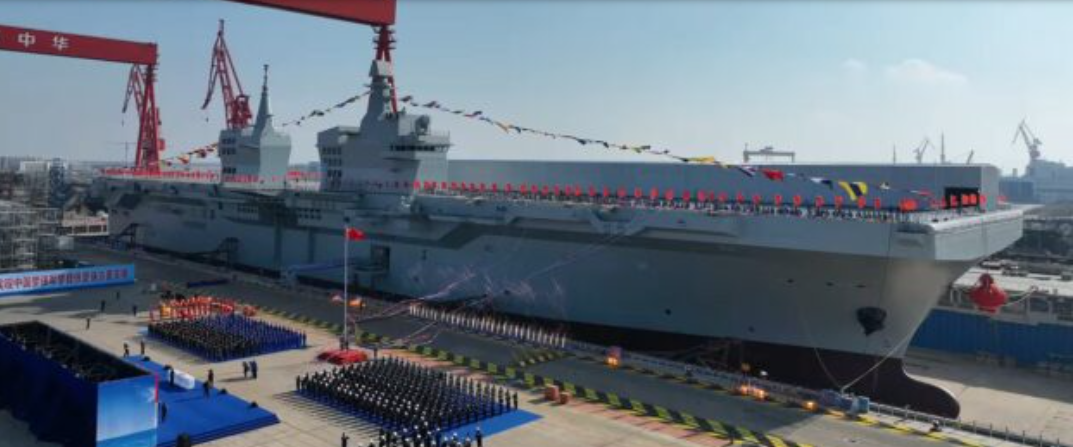
Beijing is at the forefront of developing drone carriers as combat platforms, especially compared to the United States. But will that translate into a combat advantage?
On October 30, the Chinese military announced it had successfully launched and recovered a drone – an unmanned combat aerial vehicle (UCAV) – from its drone carrier, the Sichuan. This marked the first time a drone carrier has launched a UCAV by catapult and recovered it.
The test is the latest in a steady stream of efforts to integrate autonomous systems into China’s maritime forces. While the operational effectiveness of drone carriers remains to be seen, Beijing appears to be at the forefront of developing them as combat platforms, especially compared to the United States. This development signals not only a growing comfort with drone carriers but also an emerging tool for China to coerce adversaries in peacetime and add mass in a Pacific contingency.
Drone carriers are vessels capable of launching and operating unmanned systems. Though similar to aircraft carriers in some respects, a drone carrier is built primarily around unmanned systems. An early sign of Chinese interest in the platform came in 2024, when satellite imagery revealed a wide catamaran that analysts labeled a drone carrier. What distinguishes the Sichuan from China’s earlier drone carriers, however, is its ability to launch and recover heavier drones.
The Sichuan is a Type 076 (NATO reporting name: Yulan) amphibious assault ship and the first of its kind fitted with an electromagnetic catapult, alongside arresting gear to recover aircraft – technology China has otherwise reserved for its newest aircraft carrier, the Fujian. The GJ-21 reconnaissance and strike stealth drone launched from the carrier is estimated to weigh over 10 tons, too heavy to take off from a short flight deck without a catapult.
Although the PLA was quick to claim the launch and recovery as a world first, no imagery or footage as of writing has yet been released. This is unlike the Fujian’s first catapult launches, which China publicized with video in 2025.
While China appears at the forefront of this concept, it is not alone. Turkiye’s Anadolu, an amphibious assault ship and drone carrier, can also launch and recover UCAVs. However, unlike China, its drone carrier lacks a catapult system, limiting its ability to launch and recover heavier drones.
Iran, on the other hand, converted a commercial container ship into a drone carrier, called the Shahid Bagheri. Iran claimed the carrier had an operational range of 22,000 nautical miles, while being able to conduct missions for a year without needing to refuel. However, the United States sank the drone carrier during Operation Epic Fury.
South Korea is planning to develop drone carriers. Other countries, such as Spain, France, Italy, and the United Kingdom are exploring drone carrier concepts or already integrating unmanned aerial systems into existing aircraft carrier operations.
The biggest benefit for the Chinese military from these types of tests is the data and knowledge gathered. Chinese military thinkers assert that AI and autonomous systems are leading to an era of intelligentized warfare. Under this type of warfare, data is referred to as the “new oil,” highly valuable and essential to powering these AI-enabled systems. The importance of intelligentized warfare and unmanned systems has received significant attention not only from Chinese military thinkers, but from President Xi Jinping. In his report to the 20th National Congress, Xi stressed their importance, while calling for speeding up development and formulating strategies and tactics to utilize them for potential conflicts.
While the Chinese military has responded earnestly to this directive, debates continue within the People’s Liberation Army (PLA) over the strengths and weaknesses of the drone carrier concept. Cost-effectiveness remains one of the clearest benefits of drone carriers and their associated systems. Compared to manned systems such as fighter jets, unmanned systems cost far less to procure and operate. Additionally, training drone operators would be less costly than training fighter pilots. However, the degree of autonomy these systems should have remains contested. A PLA Daily article argued that “final decisions rest with human commanders, safeguarding against errors stemming from AI’s black-box nature.”
The war in Ukraine has highlighted the importance of autonomous systems for nations worldwide, including the United States. Recently, the Pentagon announced its plans to establish the Autonomous Warfare Command (AutoWARCOM), a four-star command aimed at scaling AI and autonomous systems in the U.S. military. While greater attention is being paid to AI and autonomous systems, U.S. efforts are focused less on dedicated drone carrier concepts, and more on integrating unmanned systems into existing platforms. In part, this may be because the United States has less need for a dedicated drone carrier. With 11 aircraft carriers and a fleet of large-deck amphibious ships, the U.S. Navy can fold unmanned aircraft into existing air wings rather than build new hulls for them.
This is not for lack of experience. In 2013, the U.S. Navy’s X-47B became the first unmanned aircraft to launch by catapult from, and land on, an aircraft carrier, the USS George H.W. Bush. Rather than mature this design into a carrier-based strike drone, however, the U.S. Navy redirected its follow-on program, the Unmanned Carrier-Launched Airborne Surveillance and Strike (UCLASS) system, toward aerial refueling. The result was the MQ-25 Stingray, an unmanned aerial refueling drone that can be launched and recovered from an aircraft carrier.
The Navy is also continuing with collaborative combat aircraft, autonomous systems designed to launch and recover from aircraft carriers. Multiple U.S. companies – General Atomics, Anduril, Boeing, and Northrop Grumman – have received contracts to produce conceptual designs for these systems, aimed at enhancing the capabilities of manned fighter aircraft.
China, meanwhile, is taking a different path. For now, it is likely to keep testing what drone carriers can offer. With little combat experience to draw on, the purported benefits center on the cost-effectiveness and massing effects afforded by drone carriers and their fleet of unmanned systems, which China may be able to leverage in both peacetime and war.
Below the threshold of conflict, Chinese drone carriers can serve as a coercive force for China’s gray-zone activities. For example, drone carriers host a wide array of unmanned systems capable of fulfilling different mission types. In the South China Sea, drone carriers could conduct intelligence, surveillance, and reconnaissance, pinpointing non-Chinese coast guard and fishing vessels that purportedly “violate” China’s maritime claims.
In a Pacific contingency, Chinese drone carriers can provide additional mass alongside other naval assets. If networked effectively, drone swarms, alongside other military effects, can map, mislead, and jam adversary defenses, then strike, challenging Taiwanese and U.S. forces. As a recent Center for Strategic and International Studies (CSIS) report noted, these dispersed swarms force adversaries to burn through interceptors, expose their sensors, and question what they see. Even if the drones are downed, the interceptors would be far more expensive to replace than the unmanned systems they destroyed. Additionally, drones can act as decoys, drawing fire and sensor attention away from more traditional assets, such as fighter aircraft and naval strike groups.
But any potential application of drone carriers assumes a level of operational effectiveness. As a concept, drone carriers are still nascent; the one example that would have revealed its effectiveness in combat, Iran’s Shahid Bagheri, was quickly sunk when U.S. forces initiated Operation Epic Fury in February.
Cost is another question; while the UCAVs launched by a drone carrier are cheaper than manned fighter aircraft, the carrier itself is not cheaper to build than a traditional amphibious ship. But here, China holds an advantage few can match: as the dominant global shipbuilder and a leading drone producer, it can build both hulls and drones at lower cost and greater speed than its competitors. That capacity has fueled China’s naval buildup, and it allows Beijing to absorb the cost and risk of experimenting with platforms like the Sichuan. Whether that experimentation translates into real combat power, however, remains unproven.
You have read 2 of your 3 free articles this month.