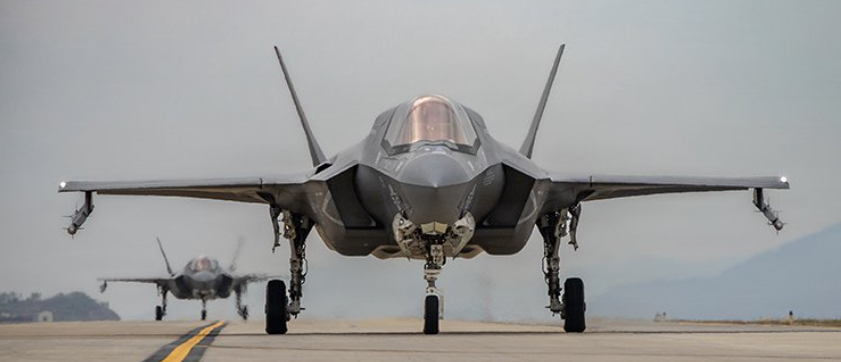
Despite spending billions of dollars on aircraft parts for the F-35 Lightning II fighter jet fleet, the Defense Department has long failed to accurately keep track of those parts, impeding overall readiness, according to a new Government Accountability Office report.
The Pentagon has put roughly $31 billion into purchasing about 26 million F-35 parts such as engines and tires, but it has kept poor records on the physical statuses of those parts, leading to inaccurate financial data, said the report, “F-35 Program: DoD Needs to Strengthen Oversight of Tens of Billions of Dollars in Parts,” released Nov. 9.
“Accountability of these parts supports mission readiness and efficiency by providing management with information such as where parts are, who is responsible for them and what condition they are in, » the report said.
The F-35 aircraft is the Pentagon’s most expensive weapon system in history, reaching cumulative costs of more than $1.9 trillion over its lifespan, the report said.
Even with significant spending on the table, the accountability and financial reporting of program parts is a long-standing weak point for the Defense Department — at least dating back to auditor findings in fiscal year 2019, the report said.
In fiscal year 2025, the department was unable to provide or obtain reliable information on its F-35 parts, meaning that certain assets were not accurately recorded in its financial statements or tracking systems, the report said. That resulted in “a material misstatement in the financial statements that could not be quantified.”
For example, the F-35 Lightning II Joint Program Office as of March “did not know the status of lost F-35 parts valued at over $85 million that GAO reported on in 2023,” nor had the office established procedures for monitoring losses as they occur, the report said.
Without an effective process in place to supervise losses, the program office will remain unaware of the full extent of deficits, and its ability to mitigate losses and detect fraud, waste and theft will remain degraded, the report said.
Also as of March, the program office had not entered approximately 17,000 parts that were in maintenance or repair status into its tracking software, totaling a value between $1.3 billion and $2.5 billion, the report said.
The program office has spent at least $17 million since fiscal year 2020 conducting physical inventories of F-35 assets throughout the contractor- and government-managed facilities holding the parts, but those inventories have failed to fully verify the existence or completeness of all parts, the report said. This is because some contractor data has been shown to be inaccurate, the locations of some subcontractor facilities holding F-35 parts are unknown to the Pentagon and parts in transit can be left out of the inventory process altogether.
The persistent F-35 oversight shortfalls will continue to contribute to a “disclaimer of opinion” on the Pentagon’s overall financial statements until the problems are adequately addressed, the report said.
Additionally, the lack of accountability surrounding these parts, given their sheer quantity, may affect the Defense Department’s ability to resolve other material weaknesses.
“The operational readiness of the DoD warfighter also depends on the accuracy of the information in these records, including asset location, quantity and condition,” the report said.
GAO gave the Defense Department four recommendations to consider, including that it develop and implement ways to keep track of F-35 part losses and educate personnel on how to better account for aircraft parts.
The Pentagon in a response letter included in the report concurred with all four of the recommendations and said it is already taking steps to address the listed problems.
“Our strategy is centered on establishing an authoritative and complete inventory baseline, which is foundational to accurately tracking and analyzing loss data,” the letter said.
The letter also noted efforts to improve training for accountable property officers to ensure the appropriate people “possess both the high-level regulatory competencies mandated by the DoW and the practical, localized skills required for the F-35 program.”